Research
Selected publications
A selection of recent work in leading journals, organized by theme. Expand any item to read the abstract, or see the full curriculum vitae for the complete list.
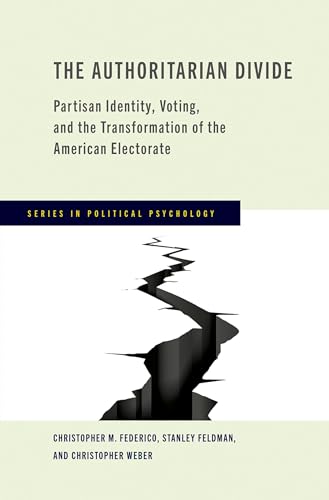
The Authoritarian Divide: Partisan Identity, Voting, and the Transformation of the American Electorate
Christopher M. Federico, Stanley Feldman, and Christopher Weber
The Authoritarian Divide shows how authoritarian predispositions — desires for social and in-group conformity — have increasingly structured American political preferences, voting, and partisanship over recent decades. Drawing on nationally representative samples, panel data, and experiments, the authors trace how voters have sorted into parties by their levels of authoritarianism (higher toward the Republican Party, lower toward the Democratic), revealing complexities including the outsized effect on White Americans, dependence on the choices parties offer, and the role of education. The analysis carries crucial implications for partisan conflict and the future of American democracy.
Ideology & Political Psychology
Authoritarianism, ideology, moral intuition, emotion, and identity — the psychological forces that structure how citizens sort, reason, and vote.
- Book 2026
The Authoritarian Divide: Partisan Identity, Voting, and the Transformation of the American Electorate
Christopher M. Federico, Stanley Feldman, and Christopher Weber
Oxford University Press · Series in Political Psychology
[summary] The Authoritarian Divide shows how authoritarian predispositions — desires for social and in-group conformity — have increasingly structured American political preferences, voting, and partisanship over recent decades. Drawing on nationally representative samples, panel data, and experiments, the authors trace how voters have sorted into parties by their levels of authoritarianism (higher toward the Republican Party, lower toward the Democratic), revealing complexities including the outsized effect on White Americans, dependence on the choices parties offer, and the role of education. The analysis carries crucial implications for partisan conflict and the future of American democracy.
- Chapter 2024
Authoritarianism and Political Conflict
Stanley Feldman and Christopher Weber
The Oxford Handbook of Political Psychology
We review recent research on authoritarianism with the goal of addressing major issues of conceptualization, measurement, and political consequences. We highlight a conceptualization of authoritarianism that identifies the desire for social cohesion and defense of ingroup norms as central to its dynamics. The consequences of authoritarianism—intolerance of dissent, out-group animosity, and support for anti-democratic leaders and parties—result from the experience of threat to social cohesion among those with authoritarian predispositions. Threats may be associated with processes of social change (changing gender norms) or changes to the status of the majority group from immigration. The role of threat helps provide a basis for understanding the conditions under which authoritarianism becomes a politically potent force.
- Article 2019
Why Are We Divided? Understanding the Social and Ideological Foundations of Partisan Sorting and Polarization
Christopher Weber and Samara Klar
Advances in Political Psychology, 40, 215–244
Americans are sorting ideologically: liberals and conservatives are more likely to respectively identify as Democrats and Republicans. They are sorting socially as well: partisans like and trust copartisans more than opposing partisans. Existing explanations rely on exogenous factors such as elite polarization, but these cannot fully explain variation in sorting. We argue that psychological characteristics help explain the tendency to sort ideologically or socially—specifically, an individual's responsiveness to internal values versus normative social pressures. Testing this with several nationally representative surveys and a survey experiment, we find strong support that a person's own tendency to respond to social cues, as opposed to ideological values, has important consequences for this process.
- Article 2019
Affective Consistency and Sorting
Nicholas T. Davis, Samara Klar, and Christopher Weber
Social Science Quarterly, 100(6), 2477–2494
Sorting is often portrayed as a mechanistic response to elite polarization: individuals recognize salient differences between the parties and match their preferences accordingly. Much less is known about the psychological and motivational processes that contribute to it. Analyzing cross-sectional and panel data from the American National Election Studies, we find that negative emotions directed toward the opposing party candidate and positive emotions toward one's own party candidate are associated with an increase in the alignment of ideological and partisan preferences—illustrating how affect contributes to consistency in mass opinion.
- Article 2014
Placing Racial Stereotypes in Context: Social Desirability and the Politics of Racial Hostility
Christopher Weber, Howard Lavine, Leonie Huddy, and Christopher M. Federico
American Journal of Political Science, 58(1), 63–78
Past research indicates that diversity at the level of larger geographic units is linked to white racial hostility, but research has not addressed whether diverse local contexts strengthen or weaken the relationship between racial stereotypes and policy attitudes. In a statewide opinion survey, we find that black-white diversity at the zip-code level strengthens the connection between racial stereotypes and race-related policy attitudes among whites—an effect most pronounced among low self-monitors, who are relatively immune to egalitarian social norms. The racializing effect is most evident for stereotypes relevant to a given policy.
- Article 2013
Mapping the Connections between Politics and Morality: The Multiple Sociopolitical Orientations Involved in Moral Intuition
Christopher M. Federico, Christopher Weber, Damla Ergun, and Corrie Hunt
Political Psychology, 34(4), 589–610
According to moral foundations theory, five foundations are central to moral intuition: the individualizing foundations (harm/care and fairness/reciprocity) hinge on the rights of the individual, whereas the binding foundations (in-group/loyalty, authority/respect, and purity/sanctity) focus on communal bonds. We argue that only certain sociopolitical attitudes relate to each cluster. Drawing on dual-process models, we show the individualizing foundations align with preferences for equality versus inequality (SDO and competitive-jungle beliefs), whereas the binding foundations align with preferences for openness versus social conformity (RWA and dangerous-world beliefs).
- Article 2013
Moral Foundations and Heterogeneity in Ideological Preferences
Christopher Weber and Christopher M. Federico
Political Psychology, 34(1), 107–126
Moral foundations theory contends that divisions between liberals and conservatives are rooted in different views of morality, with liberals disproportionately valuing the individualizing foundations while conservatives value all five more equally. We extend this by examining whether different types of liberals and conservatives value the foundations to varying degrees. Using survey data (n = 745) and a mixed-mode latent class analysis, we identify six ideological classes that favor unique social and fiscal policy positions and endorse the moral foundations in varying degrees—demonstrating considerable heterogeneity in ideology and moral preferences.
- Article 2013
Emotions, Campaigns, and Political Participation
Christopher Weber
Political Research Quarterly, 66(2), 414–428
There has been a scarcity of work examining the political consequences of discrete emotions. This article examines the political effects of anger, sadness, fear, and enthusiasm. Two experiments are administered: the first examines emotional responses to campaign messages; the second tests whether emotions influence political participation. The results indicate anger is mobilizing, increasing participatory intentions and related factors—a result then replicated using ad-tracking data. Emotions are an important factor in studying campaign effects.
Methods
Research design and measurement for opinion dynamics — repeated cross-sections, online experimental samples, social-desirability bias, and discussion networks.
- Article 2016
Social Desirability Bias in the 2016 Presidential Election
Samara Klar, Christopher Weber, and Yanna Krupnikov
The Forum, 14(4), 433–443
Partisanship is a stable trait, but expressions of partisan preferences can vary according to social context. Relying on the psychological trait of self-monitoring, we show that Americans more likely to adjust their behavior to comply with social norms (high self-monitors) were less likely to express support for Donald Trump during the 2016 election; as self-monitoring decreases, the tendency to express Trump support increases. This suggests that—at least for some individuals—there may have been a tendency to repress expressed support for Trump to mask socially undesirable attitudes.
- Article 2015
An Effective Approach to the Repeated Cross-Sectional Design
Matthew Lebo and Christopher Weber
American Journal of Political Science, 59(1), 242–258
Repeated cross-sectional (RCS) designs are distinguishable from true panels and pooled cross-sectional time series because cross-sectional units appear only once. This poses two challenges: autocorrelation threatens inferences, yet common solutions like lagged dependent variables are impossible; and available methods force a choice between aggregate- and individual-level analysis. We offer a solution—double filtering with ARFIMA methods to account for autocorrelation, followed by multilevel modeling to estimate aggregate- and individual-level parameters simultaneously—demonstrated with Monte Carlo experiments and three applied examples.
Looking for the complete record?
The full curriculum vitae lists every publication, grant, course, and appointment — available to read online or download as a PDF.